Talking about emotions is not always easy. Some people can clearly explain what they are thinking and feeling, while others may struggle to find the right words. This can be particularly true for children, but adults can also find it difficult to describe complicated experiences directly.
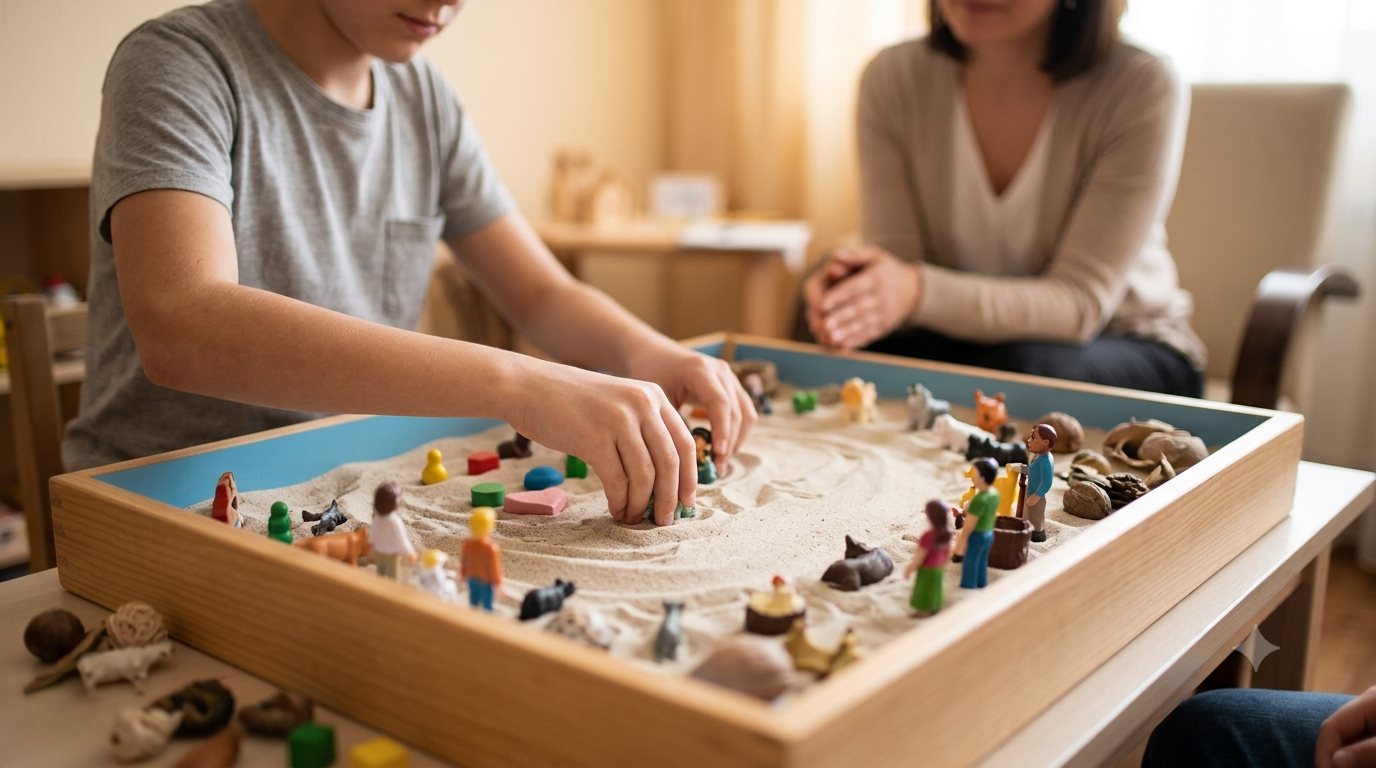
Sand tray therapy is a therapeutic approach that uses a tray filled with sand along with miniature objects and figures to provide a creative way of expressing thoughts, feelings, experiences, and personal stories. Instead of relying entirely on conversation, a person can use objects and the sand itself to create scenes that may represent aspects of their inner world.
The approach can provide a supportive environment for exploring emotions and experiences at a pace that feels comfortable for the individual.
What Is Sand Tray Therapy?
Sand tray therapy involves creating scenes or arrangements in a tray of sand using miniature figures and objects.
A therapist provides a selection of items that may represent people, animals, buildings, nature, vehicles, objects, or other aspects of everyday life and imagination.
The individual can choose objects and arrange them in the sand in a way that feels meaningful to them.
There is no single correct way to create a sand tray scene. The arrangement may represent a specific experience, a relationship, an emotion, an imagined situation, or something that is difficult to express verbally.
The therapist can then help the individual explore the scene and what it may mean to them.
Why Use Sand and Miniature Objects in Therapy?
Creative activities can sometimes make it easier to communicate experiences that are difficult to put into words.
When someone creates a scene, they can make choices about:
- Which figures to include
- Where objects are placed
- How close or far apart objects are
- What happens within the scene
- Which areas of the tray are left empty
- How the scene changes over time
These choices can provide opportunities for discussion.
The therapist does not need to assume what every object means. Instead, the individual can explain what the objects represent to them.
This allows the process to remain personal rather than relying on fixed interpretations.
How Does Sand Tray Therapy Work?
A typical session may begin with the therapist explaining the activity and providing the available materials.
The individual may then be invited to create a scene in the sand.
Depending on the therapeutic approach and the person’s needs, the therapist may provide a specific prompt or allow the individual to decide what to create.
Once the scene is complete, the therapist may ask open questions such as:
- What is happening here?
- What does this figure represent?
- How does this person feel?
- What is happening between these objects?
- What would you like to change?
- What happens next?
The conversation can help the individual explore emotions and experiences connected to the scene.
A Different Way to Express Emotions
Some emotions are complicated.
A person may know that something feels wrong without knowing exactly how to explain it. Creating a visual scene can provide another way to begin exploring that feeling.
For example, someone might create a scene showing a person surrounded by other figures but separated from them by empty space.
Rather than assuming what this means, the therapist can ask the person about the scene.
The individual may explain that the scene represents feeling alone even when surrounded by people.
This can create a starting point for deeper conversation.
Sand Tray Therapy and Children
Children may not always have the vocabulary or confidence to explain complex emotions.
They may also communicate through play, drawing, stories, movement, and other creative activities.
Sand tray therapy can provide children with another form of expression.
A child may create a scene involving family members, animals, fantasy characters, houses, or other objects. The therapist can observe the child’s choices and invite them to describe the scene.
The child remains involved in deciding what the scene represents.
Supporting Communication With Children
Parents may sometimes find it difficult to understand what a child is experiencing.
A child may say that everything is fine even when they appear upset, withdrawn, or frustrated.
Creative therapeutic activities can sometimes make conversations feel less direct and less intimidating.
Sand tray work may help create opportunities for children to communicate about:
- Family relationships
- School experiences
- Friendships
- Fears
- Changes at home
- Feelings of frustration
- Experiences that are difficult to describe
The therapist can use the child’s own explanations to guide further discussion.
Sand Tray Therapy for Adults
Although sand tray therapy is often associated with children, adults can also use creative approaches in therapy.
Adults may find it useful when they are exploring experiences that feel complicated, emotionally intense, or difficult to describe.
Creating a scene can provide a temporary step away from purely verbal discussion.
An adult might use the sand tray to represent relationships, life transitions, personal conflicts, hopes, fears, or other experiences.
The therapist can then help the individual explore the meaning behind the scene.
Exploring Relationships
Relationships can be difficult to describe because they involve multiple emotions and experiences.
A sand tray scene can allow someone to visually represent how they experience different relationships.
For example, a person may place figures close together to represent connection or place them far apart to represent emotional distance.
The important part is not the therapist’s assumption about the arrangement. The individual can explain what the scene means from their own perspective.
This can make relationship patterns easier to discuss.
Working Through Difficult Experiences
People sometimes carry difficult experiences that they have not fully processed.
Talking about these experiences may feel overwhelming.
Creative therapy approaches can provide an indirect way to begin exploring difficult material.
A therapist can work at a pace that respects the individual’s comfort level.
The sand tray does not require someone to immediately describe every detail. The person can create a scene and decide how much they want to discuss.
This can provide a sense of control during the therapeutic process.
Encouraging Imagination and Creativity
Sand tray therapy is not necessarily about creating something artistic or technically impressive.
There is no requirement to build a perfect scene.
The creative process itself can be useful because it allows people to experiment with different possibilities.
Someone might create a challenging situation and then change the scene.
They may move objects, add new figures, remove something, or create a different ending.
This can encourage reflection about choices, relationships, challenges, and possible changes.
Creating a Sense of Control
Difficult experiences can sometimes leave people feeling that they have little control over what is happening.
Within a sand tray, the individual has control over the scene.
They decide what to include, where to place objects, and whether to make changes.
For some individuals, this sense of control can make creative exploration feel safer.
The therapist’s role is to provide support rather than control the scene.
What Can a Therapist Learn From the Process?
The therapist may gain useful information from the individual’s explanations, choices, and responses during the activity.
However, it is important not to assume that a particular object automatically has one universal meaning.
For one person, a tree may represent safety. For another, it may represent loneliness or a childhood memory.
The individual is the best source for understanding the personal meaning of their creation.
The therapist can use questions and conversation to explore these meanings rather than imposing interpretations.
What Happens During a Sand Tray Therapy Session?
The structure can vary depending on the therapist and the individual’s needs.
A session may include:
- A conversation about how the person is feeling.
- An introduction to the sand tray activity.
- Selection of miniature objects.
- Creation of a scene.
- Time to observe and reflect on the scene.
- Discussion about what the scene represents.
- Exploration of emotions and experiences.
- Closing discussion about the session.
Not every session will follow the same process.
Some sessions may focus more heavily on creative activity, while others may involve a combination of sand tray work and conversation.
Is Sand Tray Therapy Only for Emotional Problems?
Sand tray therapy can be used to explore a range of personal and emotional experiences.
Depending on the therapist’s training and the individual’s circumstances, it may be incorporated into therapy involving:
- Emotional expression
- Relationship concerns
- Life changes
- Stress
- Difficult experiences
- Communication challenges
- Self understanding
- Childhood concerns
The suitability of any therapeutic approach depends on the individual and should be discussed with a qualified professional.
How Parents Can Support a Child Receiving Sand Tray Therapy
Parents may naturally want to know what their child is creating or discussing during therapy.
It is important to respect the therapeutic process and the child’s comfort while also maintaining appropriate communication with the therapist.
Parents can support the process by:
- Creating a supportive environment at home
- Avoiding pressure to explain every therapy activity
- Listening when the child wants to talk
- Respecting the child’s feelings
- Maintaining consistent routines where possible
- Discussing concerns with the therapist appropriately
The therapist can provide guidance about how parents can participate in a way that supports the child’s wellbeing.
Finding a Therapist Who Offers Sand Tray Therapy
If you are considering sand tray therapy, it can be helpful to find a qualified mental health professional with appropriate training and experience in creative therapeutic approaches.
You may want to ask about:
- Professional qualifications
- Experience using sand tray therapy
- The types of clients they work with
- Their overall therapeutic approach
- Whether sessions are available online or in person
- How parents are involved when working with children
A comfortable and respectful therapeutic relationship can make it easier for someone to engage with the process.
Frequently Asked Questions
What is sand tray therapy?
Sand tray therapy is a creative therapeutic approach that uses a tray of sand and miniature objects to help individuals express and explore thoughts, emotions, experiences, and relationships.
Is sand tray therapy only for children?
No. Although it is commonly used with children, adults can also participate in sand tray therapy when a therapist believes the approach may be appropriate for their needs.
How does sand tray therapy help with emotional expression?
It provides another way to communicate experiences that may be difficult to explain verbally. Creating scenes and discussing their meaning can help individuals explore emotions and personal experiences.
Does every object have a specific meaning?
No. Objects do not have one universal meaning. The meaning of an object depends on the individual and the context in which they use it.
Can parents watch a child’s sand tray therapy session?
This depends on the therapist, the child’s age, the goals of therapy, and the circumstances. Parents can discuss participation and communication with the therapist before sessions begin.
Is sand tray therapy a form of play therapy?
Sand tray therapy can be used within broader creative and play based therapeutic approaches, particularly when working with children. The exact approach depends on the therapist’s training.
What happens during the first sand tray therapy session?
The first session may involve an introduction to the therapy process, discussion of the individual’s concerns, and an explanation of how the sand tray activity works. The therapist may then decide whether the approach is appropriate.
Does someone need to be artistic to use sand tray therapy?
No. Artistic ability is not required. The activity is about personal expression rather than creating an attractive or technically skilled scene.
Can sand tray therapy be used alongside other forms of therapy?
Depending on the individual’s needs and the therapist’s approach, sand tray activities may be incorporated alongside other therapeutic techniques.
How long does sand tray therapy take?
The duration varies according to the individual’s goals, circumstances, and therapeutic plan. A qualified therapist can provide more specific guidance based on the person’s needs.