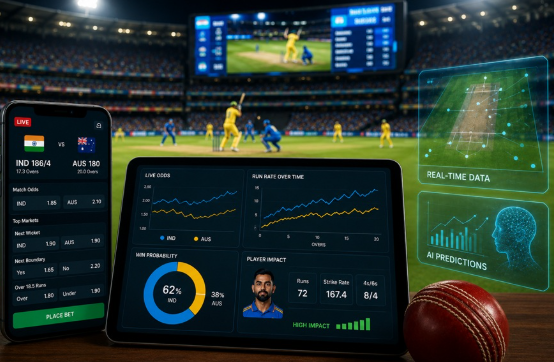
There is a structural similarity between live sports platforms and financial markets that often goes unnoticed. Both environments rely on continuous data flow, rapid reassessment of probabilities, and decisions made under uncertainty. Traditional news platforms, even analytical ones, present conclusions after the fact. In contrast, live cricket systems expose users to evolving scenarios where outcomes remain unresolved.
This difference fundamentally changes user behavior. When reading a global insight article, the reader processes information in a linear way: introduction, argument, conclusion. When following live cricket data, the user operates in loops, constantly revisiting assumptions as new information arrives. The process is closer to monitoring stock price movements than consuming editorial content.
This shift matters because it trains a different type of thinking—one that prioritizes speed, adaptability, and probabilistic reasoning over static analysis.
How Live Cricket Odds Systems Are Structured
Continuous recalibration of probability
Live cricket platforms are built on the principle that every event modifies the probability landscape. A boundary, a wicket, or even a dot ball affects expected outcomes, and these changes are reflected almost instantly in the system.
When analyzing environments such as desiplay online cricket betting odds, it becomes clear that the interface is not simply displaying scores. It is translating match events into fluctuating probability signals. For a user, this means that each update carries analytical weight. The task is no longer to observe but to interpret how a specific event alters the trajectory of the match.
This constant recalibration mirrors how traders react to news in financial markets, where even minor signals can trigger reassessment of positions.
Core mechanics behind real-time odds environments
- Event-driven updates, where each ball directly impacts probability models
- Dynamic odds adjustments, reflecting immediate shifts in expected outcomes
- Contextual overlays, including run rate, player form, and match conditions
- Minimal latency systems, ensuring that information reaches the user without delay
- Cumulative data visualization, helping users track trends rather than isolated events
These elements create a system in which information is not static but constantly reinterpreted.
Why These Systems Train Faster Analytical Thinking
From observation to active modeling
In traditional content consumption, users absorb conclusions. In real-time systems, they build them. Each update becomes an input in a mental model that the user continuously adjusts. This process develops pattern recognition skills, as users begin to identify recurring scenarios and their likely outcomes.
For example, experienced users quickly recognize how a required run rate above 10 in T20 cricket increases pressure on batting teams, especially when fewer than five wickets remain. This is not explicitly explained by the system; it is learned through repeated exposure.
Immediate feedback as a learning accelerator
The key advantage of high-velocity systems is feedback speed. When a user forms an expectation—such as anticipating a shift in momentum—the next few updates confirm or contradict that assumption. This tight feedback loop strengthens analytical skills far more effectively than delayed evaluation.
In slower systems, feedback may arrive minutes or hours later, weakening the connection between decision and outcome. In live environments, this gap is reduced to seconds.
A Practical Framework For Interpreting Live Cricket Data
Building structured thinking under time pressure
- identify the primary variable, such as run rate or wickets remaining
- evaluate how recent events affect that variable
- compare current conditions with known patterns or past scenarios
- estimate the direction of probability shifts
- update assumptions as new data arrives
This process mirrors decision-making frameworks used in trading, where multiple variables interact to influence outcomes.
Non-Obvious Factors That Influence User Performance
Cognitive load management
One of the challenges in high-speed environments is managing the volume of incoming data. Effective users do not attempt to process everything. Instead, they focus on key indicators that have the greatest impact on outcomes. This selective attention improves both speed and accuracy.
Temporal awareness
Understanding timing is critical. Not all moments in a match carry equal weight. A wicket in the final overs of a chase has a far greater impact than one in the early stages. Recognizing these temporal differences allows users to prioritize information more effectively.
Emotional regulation
High-velocity systems can trigger emotional responses, especially when outcomes are uncertain. Users who maintain a structured approach to analysis are better positioned to make consistent decisions. This is another parallel with financial markets, where emotional control is a key determinant of performance.
Why Velocity-Based Systems Redefine Digital Engagement
The success of live cricket platforms demonstrates that engagement is driven not only by content quality but by content structure. Systems that deliver continuous updates create a sense of immediacy that static content cannot replicate.
This does not mean that traditional news platforms are obsolete. Instead, it highlights a shift in user expectations. Audiences increasingly value environments where they can interact with information in real time, rather than simply consume it.
What This Means For Modern Information Platforms
Platforms that want to remain competitive must consider how to incorporate elements of velocity into their design. This does not necessarily require real-time data streams, but it does require a shift toward dynamic information delivery.
For example, breaking news platforms can integrate incremental updates rather than waiting for complete stories. Analytical platforms can provide evolving insights as new data becomes available. The goal is to reduce the gap between event and interpretation.
Why Real-Time Systems Will Continue To Expand
As users become more accustomed to high-speed information environments, their expectations will change. Static content will still have value, particularly for in-depth analysis, but it will increasingly coexist with dynamic systems that prioritize immediacy.
Live cricket platforms offer a clear example of how this transition is unfolding. By combining continuous data flow with structured presentation, they create an experience that is both engaging and intellectually demanding.
The Broader Implication For Decision-Making
The most significant impact of these systems is not entertainment but cognitive development. Users who regularly engage with high-velocity data environments become more comfortable with uncertainty, faster at identifying patterns, and more effective at updating their assumptions.
These skills extend beyond sports. They are applicable in business, finance, and any context where decisions must be made quickly with incomplete information.
Why Information Velocity Is Becoming The Core Competitive Advantage
The evolution of digital platforms suggests that speed is no longer just a feature but a defining characteristic. Systems that can deliver relevant information quickly, while maintaining clarity, will dominate user attention.
Live cricket odds platforms exemplify this trend. They demonstrate that when information is structured as a continuous process rather than a finished product, it becomes more engaging and more useful. For users, this means developing a new set of cognitive tools. For platforms, it means rethinking how information is delivered in an increasingly real-time world.