Bocce ball has been played for thousands of years, and it remains one of the most social, low-barrier outdoor games you can add to a backyard. Setting up a dedicated court at home sounds straightforward, but there are real decisions to make about dimensions, materials, drainage, and surface type. Get those right, and you end up with a court that holds up through seasons of play. Get them wrong, and you are resurfacing or re-grading within a year or two. This guide walks through everything a homeowner needs to know before breaking ground.
Understanding Official Bocce Ball Court Dimensions
Before buying a single material, it helps to know what you are building toward. Official tournament courts are significantly larger than what most residential yards accommodate, but understanding the standard gives you a sensible baseline for scaling down.
| Court Type | Length | Width | Common Use |
| Tournament (official) | 91 feet | 13 feet | Sanctioned league and tournament play |
| Recreational standard | 60 feet | 12 feet | Casual club and organized play |
| Backyard (comfortable) | 40 to 60 feet | 10 to 12 feet | Home use, family games |
| Small backyard minimum | 24 feet | 8 feet | Compact yards, beginner play |
The United States Bocce Federation specifies a court of 91 feet by 13 feet for official competition. Most homeowners do not have that kind of linear space, and that is perfectly fine. A 60-foot court still allows for a genuinely competitive game. Even a 40-foot court gives you enough room to develop real strategy. The key constraint is width. Dropping below 8 feet makes the game feel cramped and limits throwing angles considerably.
Choosing the Right Surface Material
Surface choice is where most homeowners do the most research, and rightfully so. The surface affects ball roll speed, consistency, and how much annual maintenance you will face. There are four main options, each with distinct trade-offs.
Crushed Oyster Shell or Decomposed Granite
Traditional bocce courts in Italy and France are typically packed with crushed oyster shell, crushed stone, or decomposed granite. These materials compact well, drain reasonably, and give the ball a medium-speed roll with slight unpredictability, which many experienced players actually enjoy. The downside is ongoing maintenance. Crushed surfaces shift, develop ruts over time, and need periodic raking and top-dressing. In wet climates, they can also drain poorly if the base layer was not installed correctly.
Artificial Turf
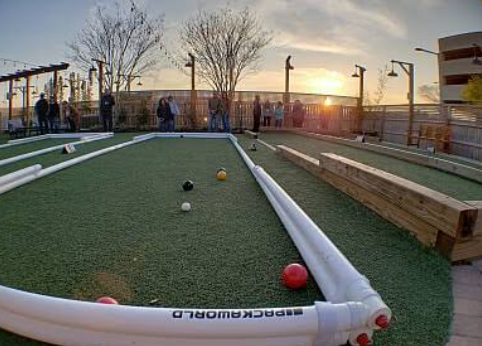
Artificial turf has become a genuinely popular choice for residential bocce courts, and it is easy to see why. A bocce ball court on turf offers a consistent roll, requires almost no ongoing maintenance, stays green year-round, and handles moderate rainfall without becoming muddy or unplayable. Turf products engineered for bocce or lawn bowling tend to have a shorter, denser pile that keeps ball speed predictable. One consideration is heat: synthetic turf can get noticeably warm in direct afternoon sun during summer months, which is worth factoring into court orientation during the planning stage.
Natural Grass
Playing bocce on natural grass is common and enjoyable, but it is not ideal for a dedicated, permanent court. Grass introduces variability in roll speed depending on moisture, mowing height, and seasonal growth patterns. Heavy use also wears down the turf quickly in the high-traffic throwing zones at each end. A lush, well-mowed lawn works fine for occasional games, but if you want a reliable court, grass alone rarely holds up long-term.
Concrete and Asphalt
Hard surfaces like concrete or asphalt are durable and low-maintenance, but they are rarely used for bocce at the recreational level. The roll speed is very fast, balls can chip or crack on impact with the hard surface over time, and the feel of the game shifts considerably. Some covered or indoor courts use these materials, but for a backyard setting, they are generally not the first recommendation.
Building a Proper Base: What Goes Under the Surface
Whatever surface you choose, the base underneath determines how well the court performs over the long term. Skipping proper base preparation is the most common mistake homeowners make, and it typically shows up within one or two rainy seasons.
- Excavate the court area to a depth of 4 to 6 inches below your finished surface level.
- Lay a weed barrier or geotextile fabric across the entire excavated area.
- Add a 3 to 4 inch layer of compactable gravel or crushed stone and compact it thoroughly with a plate compactor.
- Add a 1 to 2 inch layer of coarse sand or decomposed granite and level it carefully.
- Install your chosen surface material on top of the prepared base.
- Frame the court with treated lumber, composite board, or concrete borders to keep the surface contained.
The gravel base does two jobs: it provides drainage and it keeps the surface from shifting or sinking unevenly. Proper compaction at each layer is non-negotiable. A plate compactor can typically be rented from any equipment rental location for a half-day rate, and using one properly is far cheaper than redoing the base a year later.
Court Orientation and Surroundings
Beyond the surface itself, where you place the court in your yard has a real impact on playability and comfort. A few planning considerations are worth thinking through before finalizing the location.
- Orient the long axis north to south when possible, so neither end has players looking directly into the setting sun during afternoon games.
- Allow at least 2 to 3 feet of clear space beyond each end of the court for the throwing stance and follow-through.
- Consider overhead tree coverage: shade is welcome in summer, but falling leaves and sap can create ongoing surface maintenance.
- Keep the court reasonably level, with no more than a 1 percent grade to allow for natural water drainage without affecting ball roll.
- Plan for lighting if you want to play in the evenings. Low-profile landscape lights along the sides work well without glaring into players’ eyes.
Foul Lines, Markers, and Court Accessories
A functional bocce court needs a few key markers to keep the game organized and fair. These do not need to be elaborate, but they do need to be consistent and visible.
The foul line is drawn or marked at each end of the court, typically 10 feet from the end wall. Players must release the pallino and their bocce balls from behind this line. On crushed stone courts, foul lines are often painted with exterior spray paint or marked with a thin strip of embedded wood. On turf courts, a painted line or a flush strip of contrasting turf color works well. You will also want a center line marker, which divides the court in half and is used to determine valid pallino placement at the start of each frame. Finally, clearly defined side boundaries matter. Whether those are the physical borders of your court frame or painted sidelines, players need a clear reference.
Maintenance by Surface Type
One of the most practical questions to ask before choosing a surface is how much time you are willing to spend on upkeep. Maintenance requirements vary significantly across surface types.
| Surface | Annual Maintenance Tasks | Estimated Annual Time |
| Crushed stone or oyster shell | Raking, top-dressing, regrading low spots, weed control | 10 to 20 hours |
| Artificial turf | Brushing infill, rinsing surface, occasional seam inspection | 2 to 5 hours |
| Natural grass | Mowing, watering, overseeding, aerating worn areas | 20 to 40 hours |
| Concrete or asphalt | Crack sealing, cleaning, periodic resealing | 3 to 8 hours |
For homeowners who want to play often without spending weekends maintaining the court, artificial turf consistently comes out ahead. For those who enjoy the traditional aesthetic and do not mind the seasonal upkeep, crushed stone is a satisfying and authentic choice.
See also: Mental Health Challenges Facing Law Enforcement Officers
What a Finished Backyard Court Actually Costs
Cost depends on size, surface material, and whether you hire out any of the work. A rough breakdown helps set realistic expectations.
- DIY crushed stone court (60 feet x 12 feet): approximately $800 to $2,000 including materials and equipment rental.
- DIY artificial turf court (same dimensions): approximately $2,500 to $5,000 depending on turf quality and infill.
- Professional installation of artificial turf court: approximately $5,000 to $12,000 for a full-sized residential court, including grading, base, and turf.
- Border framing materials (wood or composite): $200 to $600 depending on material choice.
- Lighting additions: $300 to $1,200 depending on fixture style and electrical complexity.
These are general estimates based on typical residential project costs in the United States and will vary based on local labor rates and material availability. Getting two or three quotes from local contractors before committing to professional installation is always a sound approach.
Pulling It All Together
A well-built bocce ball court is one of the most consistently used backyard additions a homeowner can make. The game appeals to nearly every age group, requires no athletic conditioning, and rewards patience and precision over raw power. Whether you go with the classic look of crushed stone, the low-maintenance practicality of artificial turf, or a hybrid approach, the most important investment is the base preparation underneath. Get the foundation right, choose a surface that fits your maintenance tolerance and budget, orient the court thoughtfully, and you will have a gathering spot that gets used for many seasons without requiring a major overhaul.