For years, transitioning from an entry-level coffee maker to a high-end kitchen setup meant piecing together an assortment of separate gear. You would buy a standalone machine, match it with a heavy grinder, set up a dedicated digital scale, and find space for a tangle of power cords. While that modular approach served enthusiasts for decades, it often created counter clutter, workflow bottlenecks, and unnecessary friction during busy morning routines.
Modern coffee engineering is changing that dynamic. By uniting commercial-grade dual boilers, near-silent rotary pumps, and precision integrated grinding into unified workstations, modern home setups are redefining what it means to brew café-quality drinks at home. Here is a look at how these three core innovations work together to elevate your daily cup.
Dual Boilers: The Key to Parallel Brewing
The most significant bottleneck in basic coffee setups is thermal management. Brewing a rich, balanced espresso shot requires water maintained at a precise temperature near 200°F (93°C). Steaming milk for a latte or flat white, however, requires high-pressure steam generated above 250°F (121°C).
Single-boiler systems handle both jobs using a single chamber, forcing you to pull a shot, wait for the boiler to heat up to steam temperature, froth milk, and then cool the system back down before making another drink. This delay lets your fresh shot sit and cool, degrading its delicate crema and flavor balance.
Dual boiler architecture solves this issue by isolating the tasks into two dedicated environments:
- Brew Boiler: Maintained exclusively at lower temperatures with digital PID (Proportional-Integral-Derivative) control for exact extraction precision.
- Steam Boiler: Dedicated entirely to generating dry, high-pressure steam on demand.
Operating two independent boilers allows you to extract espresso and texture milk at the exact same time. This parallel workflow cuts preparation time in half, preserves drink temperature, and ensures smooth, repeatable results when serving family or hosting guests.
See also: How Life Coaching Can Support Your Employment and Career Goals
Rotary Pumps: Flat Pressure and Near-Silent Operation
While heating systems handle temperature, the pump serves as the engine that builds the 9 bars of pressure needed for authentic extraction. Most entry-level appliances rely on vibratory pumps, which use a rapidly pulsing piston that creates a loud, rattling buzz across your kitchen counter.
Upgrading to a setup featuring a rotary pump transforms both performance and acoustics:
- Quiet Operation: Driven by a smooth, spinning electric motor, a rotary pump produces a soft, low-frequency hum rather than a sharp vibrating rattle.
- Instant, Flat Pressure: Rotary mechanisms deliver smooth, immediate 9-bar pressure without the minor pulsing inherent to piston-driven designs. This flat pressure profile reduces the risk of channeling—where water carves cracks through the coffee puck—resulting in cleaner, sweeter shots.
- Direct Water Line Plumbing: Unlike vibratory units that struggle with pressurized tap connections, rotary pumps thrive on main water lines. Plumbed setups eliminate daily water tank refills and enable gentle line-pressure pre-infusion.
Understanding how different pump mechanisms regulate flow is an essential part of evaluating any internal espresso pump design when shopping for long-term reliability.
Integrated Grinding and Scaling: Workflow Simplified
A high-performance machine cannot save a shot if the coffee grounds are unevenly sized or incorrectly weighed. Traditionally, achieving precise doses required a separate, bulky espresso grinder and a thin digital scale tucked under the portafilter.
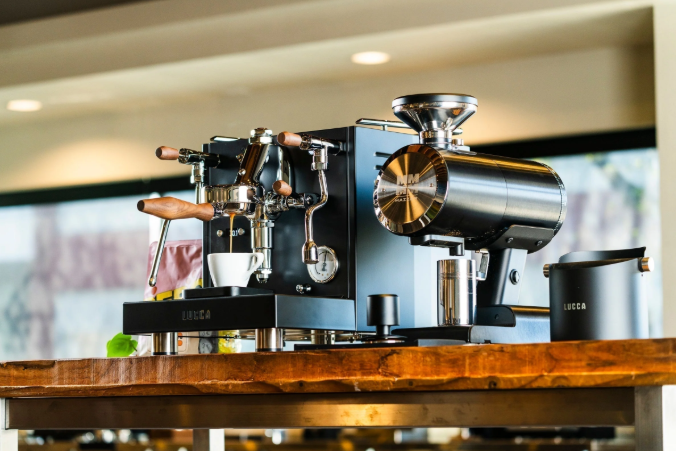
Modern integrated workstations embed commercial-grade stepless grinders and gravimetric scales directly into the machine frame. This shift delivers three major workflow advantages:
- Grind-by-Weight Automation: Built-in scale sensors measure the exact mass of coffee grounds entering your portafilter in real time, stopping the grinder automatically at your set dose (e.g., 18.0 grams).
- Auto-Stop Extraction: Gravimetric scales inside the drip tray monitor liquid yield in the cup, automatically cutting off the pump when your target brew ratio is hit (e.g., 36.0 grams).
- Zero Counter Clutter: Combining the grinder, scale, and brewing engine into a single chassis reclaims valuable counter space and eliminates messy transfers between separate gadgets.
Investing in a feature-complete prosumer espresso machine that combines dual boilers, rotary mechanics, and integrated grinding turns morning coffee preparation into a smooth, professional ritual.
Practical Considerations Before Upgrading
Before choosing a high-end integrated setup, consider a few practical kitchen factors:
- Counter Clearance: Dual boilers and integrated hoppers create a taller, heavier footprint, so measure the space beneath your upper kitchen cabinets carefully.
- Water Quality: To protect brass, copper, and stainless steel heating elements from scale buildup, always use soft, filtered water or install an in-line filtration system.
- Warm-Up Time: Heavy brass groupheads and dual water volumes require 15 to 20 minutes to saturate thoroughly with heat, though smart plugs or built-in timers easily automate warm-up schedules.
Final Thoughts
Upgrading your home coffee routine is about more than buying new appliances—it is about removing friction from your morning ritual. By uniting the thermal stability of dual boilers, the quiet precision of rotary pumps, and the hands-free convenience of integrated grinding, modern prosumer equipment bridges the gap between commercial coffee bars and home kitchens. The result is an effortless, enjoyable workflow that delivers rich, balanced espresso every single day.